
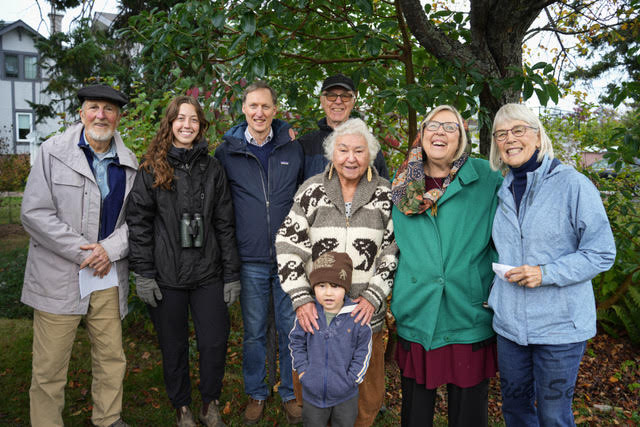
October 18th was All Buffleheads Day 2025!
Buffleheads are North America's smallest diving sea duck. In the summer, they're found throughout the aspen parkland belt of Western Canada and Alaska. Amazingly, buffleheads rely entirely on Northern flickers for their nesting sites, having evolved their small size to fit the woodpecker's tree cavities.
In the winter, many buffleheads migrate to the open lakes, harbours, coastal bays, and tidal creeks of the Salish Sea—with remarkable punctuality. Buffleheads have been returning to the Shoal Harbour Migratory Bird Sanctuary in Sidney at the exact same time every year (October 15th — the 297th day of the solar cycle)!
The Friends of Shoal Harbour created All Buffleheads Day not only to celebrate the birds’ return but to inspire action and connection. The event aims to secure Shoal Harbour’s protection in local community plans, unite governments, First Nations, organizations, and residents in managing the Saanich Peninsula’s lands and waters, and encourage families to explore and appreciate nature in their own “naturehood.”
This year, we had the privilege of joining the group of speakers, including MP Elizabeth May and Tsawout Elder Mavis Underwood. We spoke about the connection that beach-spawning forage fish have to our coastal birds and the importance of protecting our natural shorelines—a connection that's direct and unavoidable: no eggs, no fish, no birds! Many of the coastal birds we cherish, including buffleheads, rely on healthy nearshore food webs supported by forage fish such as surf smelt and Pacific sand lance. These fish spawn on intertidal beaches where proper sediment size, shading, and intact coastal processes allow eggs to survive and hatch. When shorelines are hardened with rock walls or altered through excavation, those spawning beaches—and the life they support—are lost.
Across the region, a concerning rise in shoreline armouring by private landowners doesn't just affect individual properties, but eliminates shared public beaches, disrupts sediment movement, reduces resilience to sea-level rise and storms, and undermines cultural, ecological, and recreational values. Recent enforcement action at a property in Roberts Bay highlights how quickly these impacts can occur when shoreline protections fail to keep pace with development pressure.
All Buffleheads Day reminds us that identifying important habitat—like Shoal Harbour—is only the first step: protection must follow. Coastal birds, forage fish, salmon, and people all depend on intact, living shorelines, creating a critical opportunity for municipalities, residents, and senior governments to work together to strengthen coastal protections and prioritize nature-based shoreline solutions. Celebrating buffleheads is also a call to action: protect the shorelines they depend on, support policies that keep beaches natural, and speak up when shared coastal spaces are at risk.