
Stream Stewardship
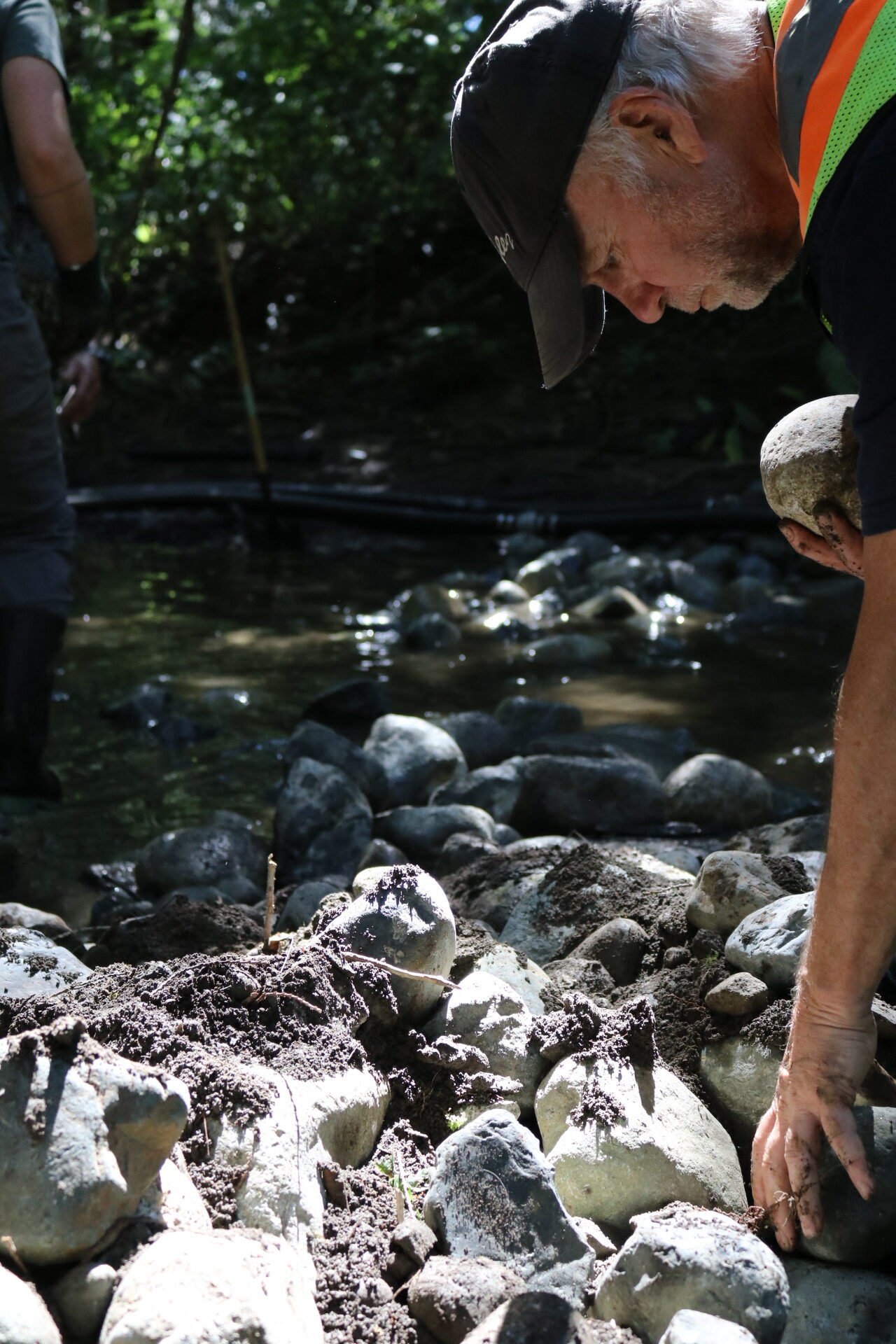
We support more than 15 volunteer stewardship groups that operate in over 13 Greater Victoria watersheds, providing technical advice, capacity building, access to funding, training, and other resources. We take a leadership role in teaching best practices in stream care, conservation, and restoration. To assist with complex stream restoration and enhancement projects, we conduct site assessments, plan projects, and obtain permits.
The objectives of these collaborative partnerships are to educate the public about the importance of watershed resources, facilitate communication and cooperation in watershed management, and provide volunteers with the training and support required to protect and restore aquatic and riparian habitat.
Our dedicated stewards are the ‘eyes and ears’ of local watershed conservation, monitoring stream conditions, counting salmon, and alerting authorities when there are problems with local streams. These dedicated volunteers donate thousands of hours each year to restore streams, plant native species, remove invasive species, collect water samples, release salmon fry, and much more.
Stewardship Groups
For years, Friends of Bowker Creek Society has supported the restoration and enhancement of the Bowker Creek watershed to a healthy state, guided by the vision and goals of the Bowker Creek Blueprint—a long-term collaborative watershed action plan developed with local governments and community partners. The group works to improve water quality and habitat, raise community awareness of watershed issues, and foster community-based stewardship that enhances riparian green space and connects neighbourhoods along the Bowker Creek corridor. They engage in projects such as community education and advocacy, riparian restoration, salmon recovery initiatives, and promotion of rain gardens and other Green Stormwater Infrastructure (GSI) to reduce runoff and pollution in the urban watershed. Their efforts complement broader municipal and regional work to realize a healthy Bowker Creek that supports native vegetation, wildlife habitat, and community well-being across Saanich, Victoria and Oak Bay. Through volunteer involvement and partnerships with groups like PSS, Friends of Bowker Creek Society continues to make meaningful progress toward ecological renewal and watershed resilience.
Friends of Tod Creek Watershed, active for 30 years, is dedicated to protecting and enhancing the biodiversity and integrity of the Tod Creek watershed. Their work includes restoring multiple creek sections, stewarding Whitehead Park and South Prospect Lake Park through Saanich’s Pulling Together program, conducting monthly water quality monitoring at key lakes and streams, educating and supporting property owners on land stewardship and restoration, and advocating for policies that safeguard the watershed. PSS has supported them with on-the-ground restoration, water quality monitoring, grant applications, and the development of a restoration and preservation plan for Tod Creek Flats.
Friends of Maltby Lake Watershed Society is a registered BC non-profit and Canadian charity dedicated to conserving the ecological values of the Maltby Lake watershed at the headwaters of the Tod Creek, including riparian, Garry Oak, and coastal Douglas fir ecosystems and the sensitive flora and fauna they support. The group works to protect wildlife habitat, create habitat corridors, reduce pollution, and educate the public and stakeholders about the ecological and cultural significance of this delicate landscape. Through community engagement, advocacy, habitat protection efforts, invasive plant management, native planting, and environmental education, Friends of Maltby Lake Watershed Society strives to keep Maltby Lake and its surrounding lands wild and thriving for future generations.
For nearly 15 years, Friends of Shoal Harbour (FOSH) has been dedicated to the care and future management of the Shoal Harbour Migratory Bird Sanctuary, which was established in 1931 to protect the more than 50 species of visiting and resident birds found there. They host public events and regular meetings, engage in issues such as beach protection and abandoned or derelict vessels, and track Official Community Plan (OCP) processes in North Saanich and Sidney. FOSH has collaborated informally with PSS on beach protection conversations and has received support for their annual All Buffleheads Day celebration each October.
Dedicated volunteers with the Bilston Watershed Habitat Protection Association have worked for more than 30 years to protect healthy waterways, aquifers, and biodiversity in the Bilston Watershed by facilitating public education and awareness, removing invasive plant species and planting native species, enhancing creek flows and fish habitat, and monitoring water quality.
The 3,174 hectare watershed spans significant areas of Langford, Metchosin, Sooke Hills Wilderness Regional Park (Juan de Fuca Electoral Area), and a thin slice of Colwood. Dozens of creeks and wetlands, all leading to Bilston Creek and Sitting Lady Falls in Witty’s Lagoon Park, are home to species of concern including coastal cutthroat trout, northern red-legged frog, sharp-tailed snake, and wandering salamander.
Formed in 2018, the Beaver Elk Environmental Stewards (BEES) is a community-based stewardship group comprised of local families, neighbours, anglers, and other lake users united in their intent to see Elk/Beaver Lake and its surrounding environment restored to health and sustainability. BEES works to build community pride in this regional park and strengthen collaboration among governments, stewardship groups, and residents to support active, ongoing care of the lakes, parklands, and the larger Colquitz Watershed. Members participate in learning, planning, and action around water quality, ecosystem health, and habitat protection, and the group aligns its efforts with partners including Peninsula Streams & Shorelines, the Colquitz Coalition, and Victoria Golden Rods and Reels to advance shared goals for ecological restoration and resilient, accessible natural spaces at Elk/Beaver Lake.
The KENNES Watershed Stewards is an informal group of concerned and dedicated community members working to care for and protect the KENNES (Hagan-Graham) Watershed. Through local advocacy, habitat clean-ups, invasive plant removal, and collaboration with partners, they help raise awareness of watershed issues and support grassroots efforts to enhance ecological health and community connection to this important local waterway.
KEL,SET (Reay Creek) Watershed Stewards is a community-formed group focused on addressing historical contamination issues in Reay Creek and the surrounding watershed. Through local advocacy, habitat clean-ups, invasive plant removal, and collaboration with partners, the group works to raise awareness of watershed challenges and support efforts to protect and improve water quality, habitat, and ecological resilience in the Reay Creek Watershed.
Formed in 2013, Friends of Swan Creek has been dedicated to restoring and stewarding Swan Creek, which flows from Swan Lake to the Colquitz River mainstem. The group’s mission is to re-establish healthy aquatic and riparian ecosystems while building public awareness of watershed issues and fostering a strong working relationship with the District of Saanich Parks and Urban Forestry. Ongoing efforts include invasive species removal along riparian and park corridors, monthly water quality monitoring at 8–9 sites (tracked through Water Rangers), instream restoration and maintenance of multiple riffles and spawning gravel, and participation in annual fall coho spawner and redd counts. PSS has been a critical partner, providing staff support, technical expertise, and resources that have made the group’s restoration and monitoring work possible.
Formed in 2022 by PSS, the Friends of Millstream Watershed is a community stewardship group dedicated to protecting and enhancing the integrity and biodiversity of the Millstream Watershed. Guided by a mission to restore and safeguard Millstream Creek and its riparian corridor, the group focuses on hands-on, community-based action while raising public awareness of the watershed’s ecological importance. Members regularly participate in clean-ups, invasive species removal, native planting and staking, and fish ladder maintenance throughout the watershed. To build local capacity and stewardship skills, PSS also delivered a Streamkeepers training course with the group in 2023, supporting long-term community involvement in monitoring, restoration, and watershed care.
Friends of Victoria Harbour Migratory Bird Sanctuary is a community-based group dedicated to promoting conservation, stewardship, and public engagement for the historic Victoria Harbour Migratory Bird Sanctuary—the first sanctuary established in Pacific Canada, protecting critical coastal and marine habitat for hundreds of bird species along Greater Victoria’s waterfront. The group supports habitat revitalization and awareness through regular bird surveys, guided walks, educational outreach, community science initiatives, and partnerships with local organizations and the Greater Victoria NatureHood collaboration to connect residents with urban nature and advocate for healthy ecosystems within the sanctuary.
Formed in 2018, Roberts Bay Residents is a volunteer group dedicated to preserving the ecology of Roberts Bay by fostering ecological understanding among neighbours through newsletters, relationships, and hands-on projects. In partnership with PSS, they have supported the Mermaid Creek Salt Marsh Restoration Project and participated in invasive plant removal, European green crab trapping, and forage fish beach spawning surveys. Independently, they produce a monthly e-newsletter, have contributed to Sidney’s Official Community Plan rewrite in 2022 (resulting in the expansion of the recognized Environmentally Sensitive Areas (ESAs) and changes to the Development Permit rules), monitor eelgrass, report creosote logs, advocate for wildlife-safe fireworks, and collaborate with Friends of Shoal Harbour (FOSH) on community education and events. Currently, they are working with the Saanich Peninsula Environmental Coalition (SPEC) via PlaceSpeak on Check Up!, an environmental report card assessing municipal performance. Support from PSS has greatly enhanced their capacity through resources, training, and technical expertise.
An offshoot of the Goldstream Volunteer Salmonid Enhancement Association, this group actively works to sustain a coho salmon run in Millstream Creek, a stream that was previously barren of returning salmon. Through the construction and ongoing maintenance of a series of five fishways over the past 20 years, volunteers continue to support fish passage and recovery, helping increase returning adult coho numbers and maintain access to upstream habitat.
For nearly 50 years, Victoria Golden Rods and Reels has been a volunteer-run fishing and social club, bringing together anglers of all experience levels to share knowledge, enjoy freshwater and saltwater fishing, and promote conservation-minded stewardship. Founded in 1977, the club supports community education through regular meetings, presentations, fly-tying sessions, and outings, while also contributing to habitat and water quality improvement projects across the region. Notably, the club has played a leadership role in conservation initiatives such as the Elk/Beaver Lake Initiative and earlier restoration work in the Colquitz watershed, collaborating with local governments, PSS, and other partners to improve aquatic habitat, address invasive species, and protect the ecological and recreational values of local waterways.
Formed in 1952, the Esquimalt Anglers Association is a long-standing community organization that supports recreational fishing and boating in Esquimalt. The group operates a clubhouse, boat-launch ramp, and approximately 300 feet of floats, providing important access and amenities for local anglers and boaters. Members are also actively involved in salmon enhancement and stewardship, including long-term volunteer support at the Goldstream Hatchery and operation of a coho counting fence and enhancement activities on Craigflower Creek.
A founding member of PSS, the Sidney Anglers Association has been bringing together recreational anglers with a shared commitment to fishing, conservation, and stewardship in the Sidney area since 1977. The group fosters interest in rod and reel fishing while actively supporting the protection and recovery of salmon and their habitats. Members contribute volunteer time to a wide range of watershed and shoreline initiatives, including salmon monitoring and DNA-based research, herring spawn projects, and other hands-on conservation efforts, helping to advance community-driven fisheries stewardship and science-based restoration across the region.