
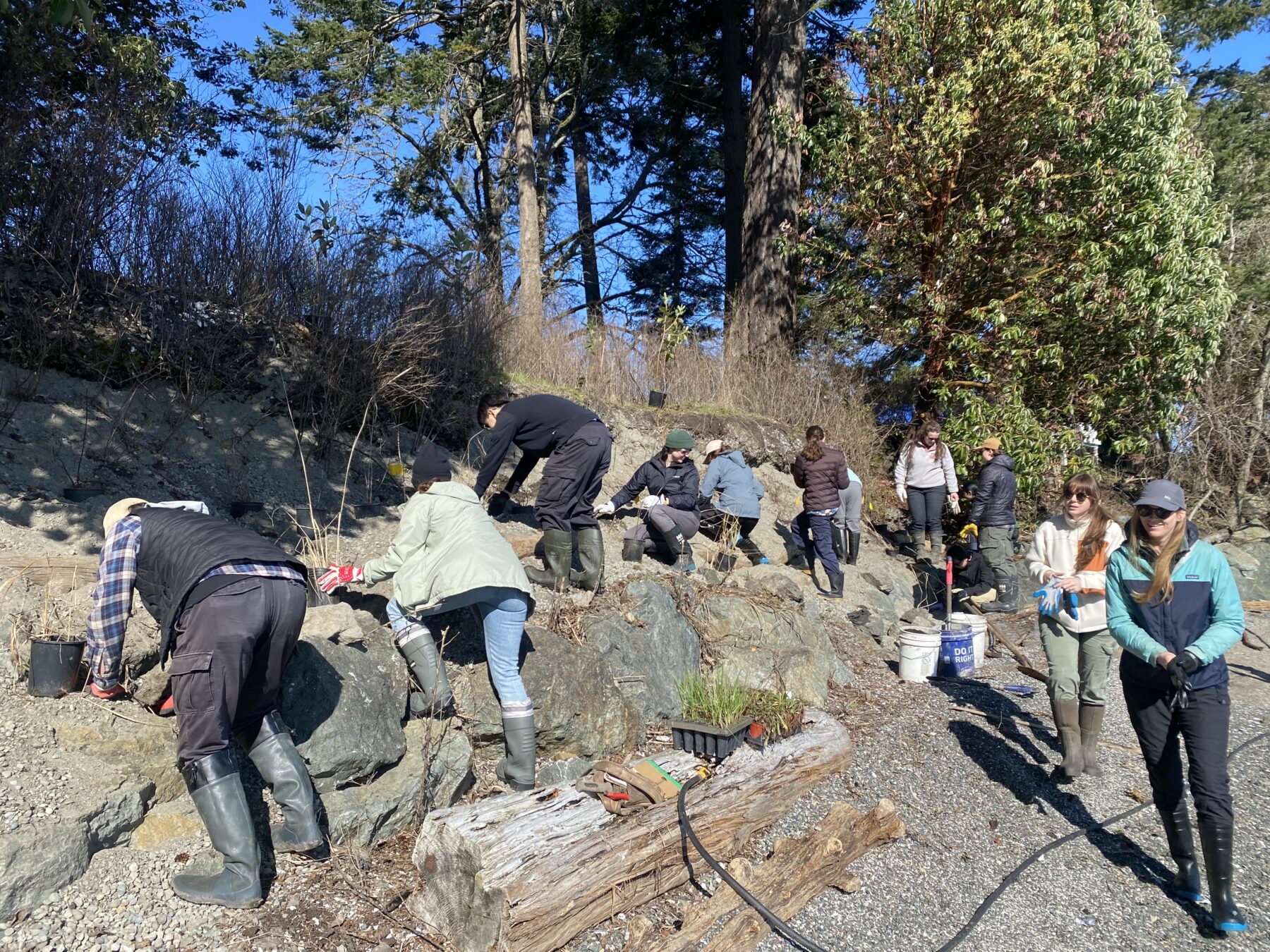
On a sunny spring morning in March, the sounds of gentle waves on the shoreline are punctuated by excited voices approaching a beach in the middle of a transformation. These are the lands of the W̱SÁNEĆ People, located on the north end of what is known today as the Saanich Peninsula, and the thick midden layers exposed on the coastal banks are a testament to their ongoing and ancestral ties to this space.
Small survey flags and native plants waiting patiently in their pots dot the area, placed there under the watchful eyes of cultural monitors of Nation members and their partner in this endeavour—Peninsula Streams Society (PSS). Together, they have undertaken the ambitious and meaningful task of restoring the abundance of life that this beach in Tsehum Harbour once supported, all the while honouring those who came before them and protecting that legacy for those who will come in the future. Their goals are numerous: protect the cultural heritage contained within the midden from accelerating coastal erosion, bring back the habitat to support forage fish who are the foundation of this marine ecosystem, and replace the aggressive invasive plants with ecologically and culturally important native species. PSS and Tseycum First Nation have spent years planning this work at Nymph Point Park and in 2026 it is well underway.
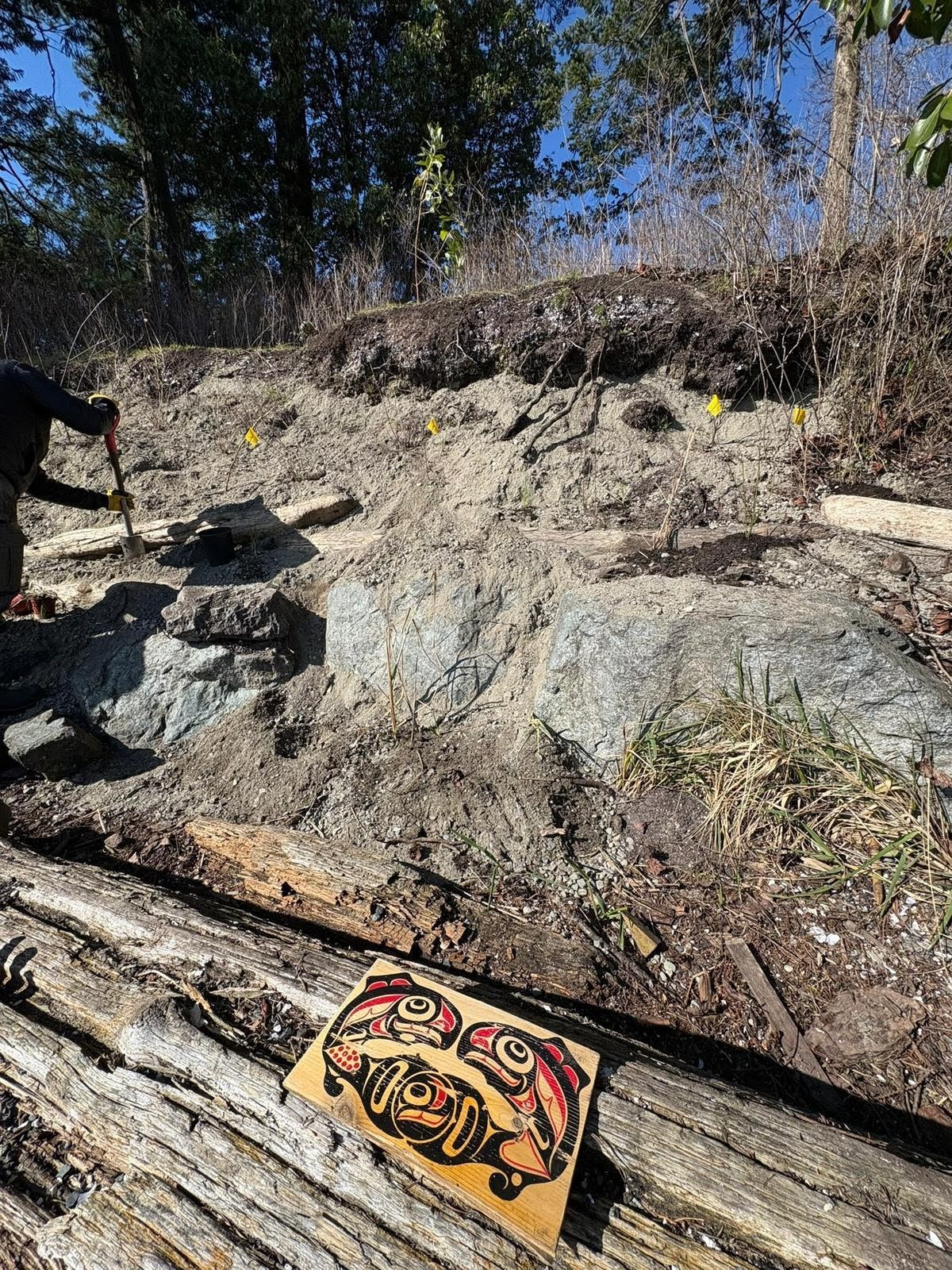
A ‘living shoreline’ approach to coastal erosion mitigation and ecological restoration in action. A section of the midden at Nymph Point Park can be seen in the eroded bank, soon to be protected by native species planted through this project. Photo courtesy of Jayni Chang.
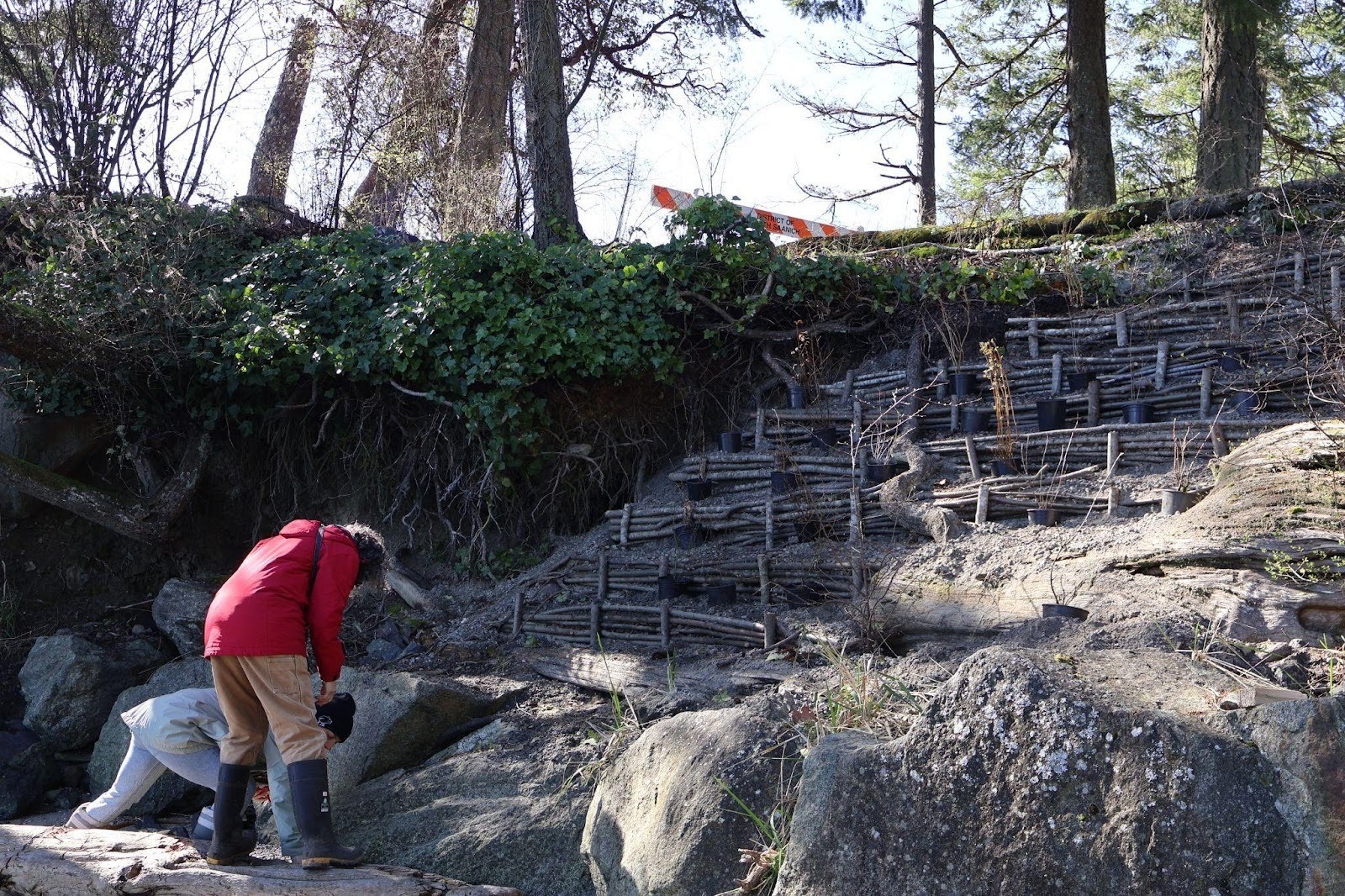
Willow stems woven into waddle fencing, and interplanted with native species will stabilize this bank that was rapidly eroding. This will protect the cultural heritage and ecological values at this beach, and enable further interventions to remove invasive species to take place. Photo courtesy of Emma McLean.
On this particular day, the buzzing voices belong to a group of students who have just hopped off the ferry for a multi-day trip exploring some of southern Vancouver Island’s most exciting ecological restoration initiatives. They are from the British Columbia Institute of Technology’s (BCIT) MSc in Ecological Restoration program, invited to the site by PSS to learn about the cultural and technical processes bringing this project to life, and to lend a hand planting native species while they're at it.
They’re greeted at the entrance by Kyle Armstrong, Executive Director of PSS and himself an alumni of this program. Listening as Kyle offers inspiration and knowledge, this next generation of restoration practitioners benefits from the kind of reciprocal relationship upon which ecological restoration thrives. Relationships like this are what lead restoration initiatives to success and long-term resilience, and they are central to PSS’ mandate of community-engaged, science-based ecological restoration.
Kyle leads the group around the area, explaining the impacts of land use and relational changes on the site, and the complexities of restoring culturally sensitive areas. He shows the students the methods being employed to suppress Himalayan blackberry and English ivy without disturbing the ground surface where the midden is shallow. A thick layer of soil caps a cardboard barrier above the chopped-back invasives, robbing the robust invaders of sunlight and knocking them back enough to establish a diverse native vegetation community with species like Douglas firs, Nootka rose, and snowberry—hopefully for good.
Walking them along the beach he points out the marked differences between the ends of the beach, where PSS’ forage fish surveys have found an abundance and high survivorship of the crucial animals’ eggs in the relatively undisturbed zones and a stark reduction in numbers and survivorship of them at the degraded end, where conditions are no longer suitable for their spawning and feeding. While the objectives of the improved marine riparian area, public access, and creosote debris removal have been met, PSS waits on a slow provincial permitting process before it can work to remove the large chunks of concrete and cobble peppered along the degraded beach, and nourish the shore with locally sourced sediments suitable for spawning by forage fish such as surf smelt and Pacific sand lance. The tour ends with an introduction to the intricate waddle fencing constructed with willow stems that will hold the midden back from eroding into the sea and to the planting which is replacing lost vegetation once responsible for this important service of moderating erosion processes. For all the questions that Kyle answered and the learnings garnered by the students from him and the land itself, there are many more to come on the group's next stop: W̱JOȽEȽP (Tsartlip) First Nation and PSS’ restoration of the KÉNNES (Hagan-Graham) Watershed at MÁWUEĆ.
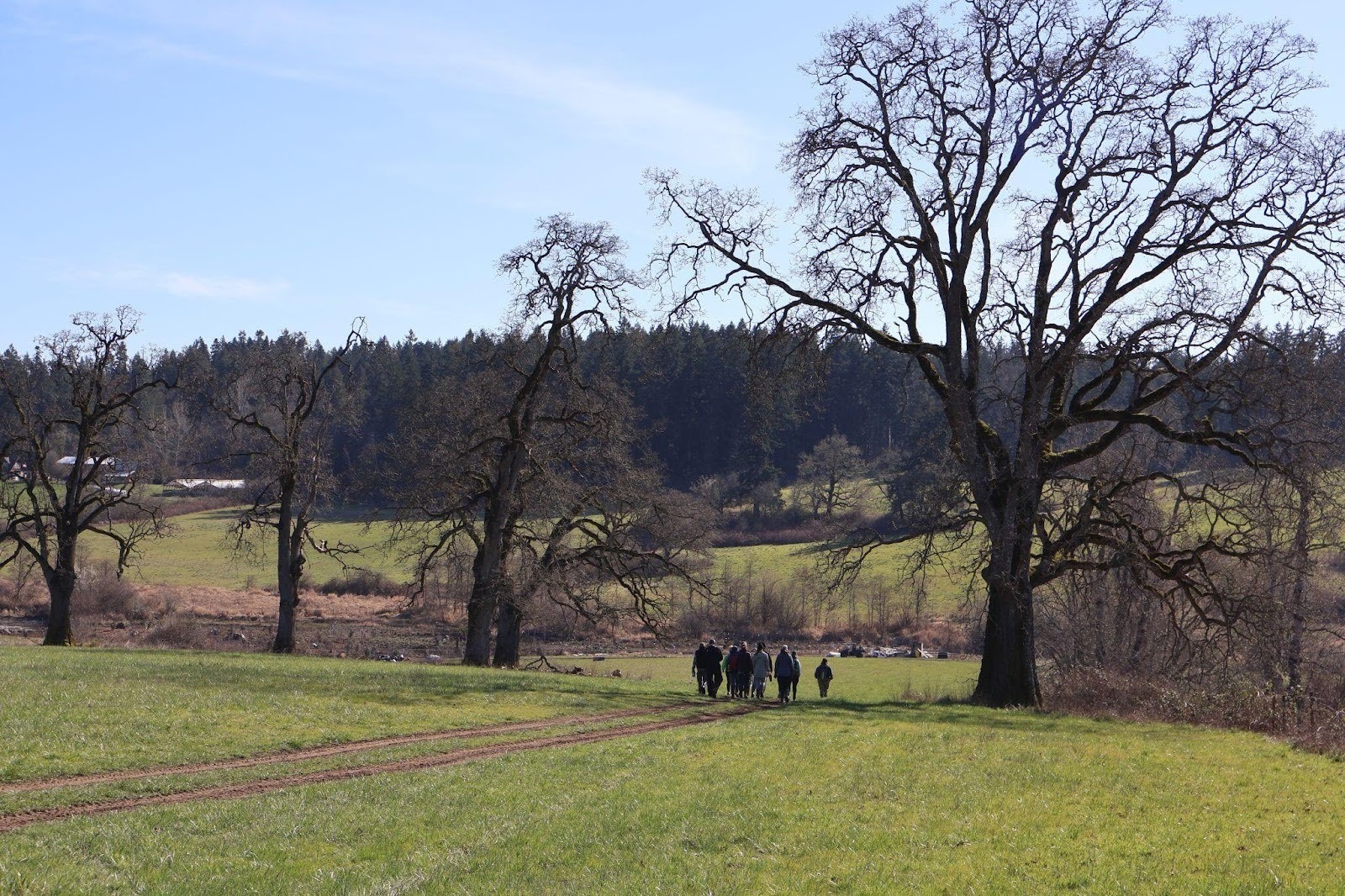
The Ecological Restoration MSc students from BCIT walk through mature Garry oaks as they approach the restoration area at MÁWUEĆ. After purchasing the site in 2020, the Tsartlip Nation has restored a section of the creek area in partnership with PSS. Photo courtesy of Emma McLean.
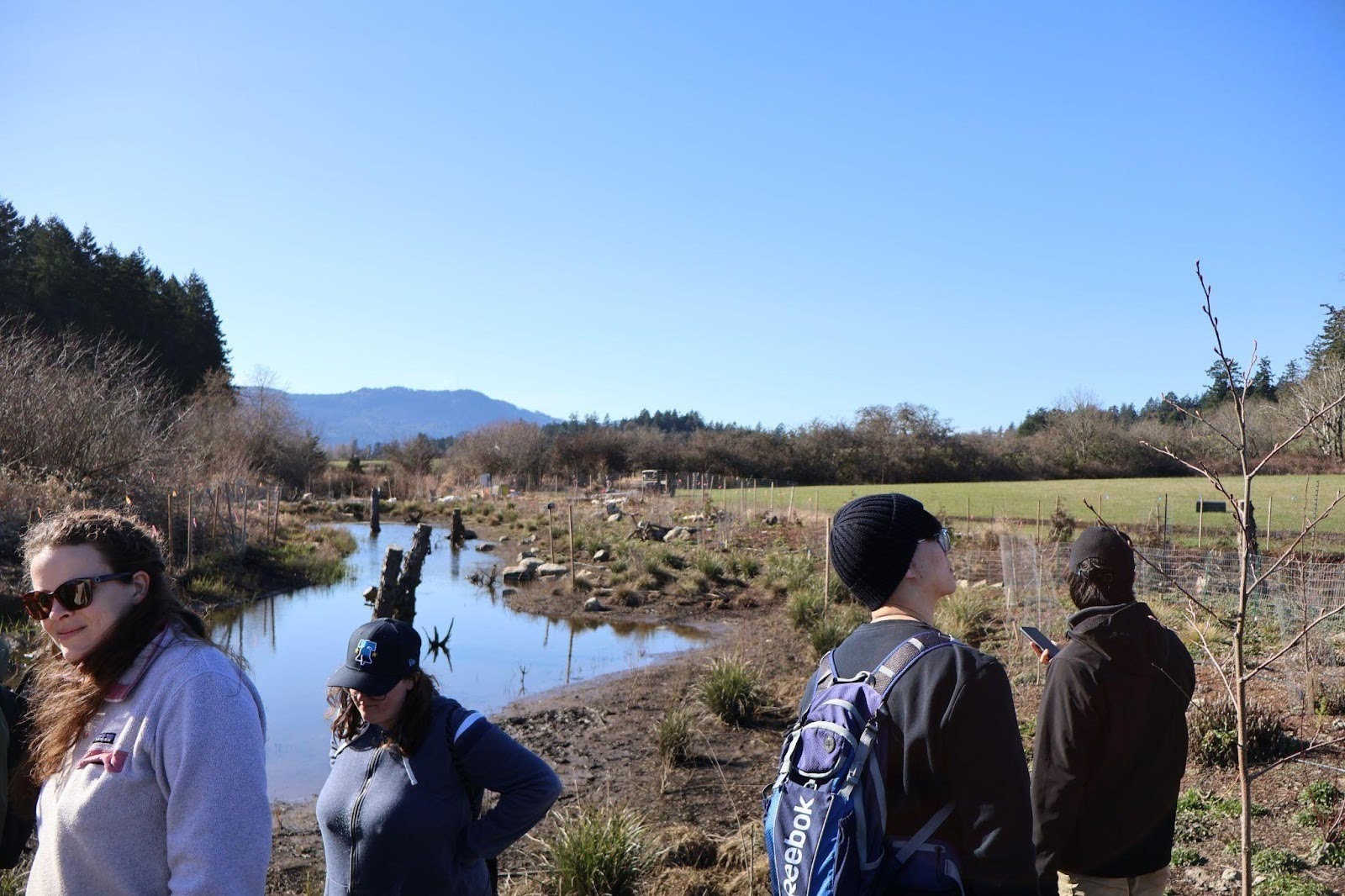
The newly created off-channel habitat and revegetated riparian zone at MÁWUEĆ have already welcomed back many coastal cutthroat and a family of beavers. Restoration continues, and those interested are encouraged to check PSS’ website and socials for opportunities to contribute. Photo courtesy of Emma McLean.
Lands converted for western agriculture share a suite of degraded traits, and MÁWUEĆ is no exception: compacted soils, low biodiversity, loss of riparian habitat, prevalence of invasive species, and unhealthy nutrient levels. These challenges are described to the graduate students by Katrina Adams, PSS’ Senior Aquatic Biologist, and Tsartlip’s Ecological Restoration Coordinator, Mike Desjarlais. The duo explain the place’s history, from its millenia as a Tsartlip harvesting ground for camas and trout, to its more recent time as a conventional western farm. With a brightness in their eyes, they tell us of its next chapter: a culturally and ecologically restored place where traditional plant harvesting, renewed relationships, and support for the whole ecosystem is centred. Mike and Katrina walk the students across the lands, sharing stories of successes and surprises in bringing prescribed burning practices back, and of their complicated, unfolding relationship with a newly arrived beaver family.
Seeing the compounding benefits of PSS and Tsartlip collaboratively planning and performing this work reinforces the lessons taken from Tsehum Harbour and demonstrates that healing the land, repairing colonial injustice, and growing communal resilience in the face of climate and social change is possible with honesty, respect, and commitment. With these tenets in mind, the BCIT cohort spreads across the site at the direction of Katrina and Mike to lend their hands with willow staking in the riparian zone, installing a bat box, and removing invasive species. Nothing cements lessons on the land like sweat, dirt, and a job well done!
Much work has already been completed thanks to this partnership and the countless hours of volunteers. Hagan Creek, previously turned into an agricultural ditch and overtaken by invasive grass, has been complexified with the addition of revegetated off-channel habitat. Here, Katrina excitedly shares that she has observed dozens of coastal cutthroat trout using the new habitat within mere months of its restoration. Newly planted trees and shrubs will shade the streamside keeping water temperatures suitable for the fish in the ever-hotter summers, while feeding the base of the ecosystem and providing harvesting opportunities for the Tsartlip Nation.
With full hearts and minds, the students bid thank you and farewell to Mike, Katrina, and the rest of the team of dedicated people working to reinvigorate the abundance contained in this watershed. Heads swirling with visions of a healthy, connected, and just future, and hands sore from contributing a small piece to this grand image, the cohort drives off to continue learning from the growing network of projects like these. At dinner, they reflect on the generosity shown by PSS and the W̱SÁNEĆ communities with whom they had the honour and pleasure of briefly working alongside. Certainly the momentum built here will be carried forward by these graduate students into their futures as restorationists. Not only are these projects a message of hope, they are also an avenue of action for each of us to play our part in correcting the mistakes of the past, and building a world we are proud to pass down to the future.
Ziggy Sveinson
MSc Student, BCIT